At PENABUR Intercultural School (PIS), we believe that the most meaningful learning often begins with a simple question: “How does nature solve this problem?”
One approach that beautifully captures this spirit is Biomimicry, an interdisciplinary concept that seeks sustainable solutions to human challenges by emulating nature’s time-tested patterns and strategies. By integrating STEAM (Science, Technology, Engineering, Arts, and Mathematics), biomimicry offers a rich framework for students to explore, question, and innovate.
What Is Biomimicry?
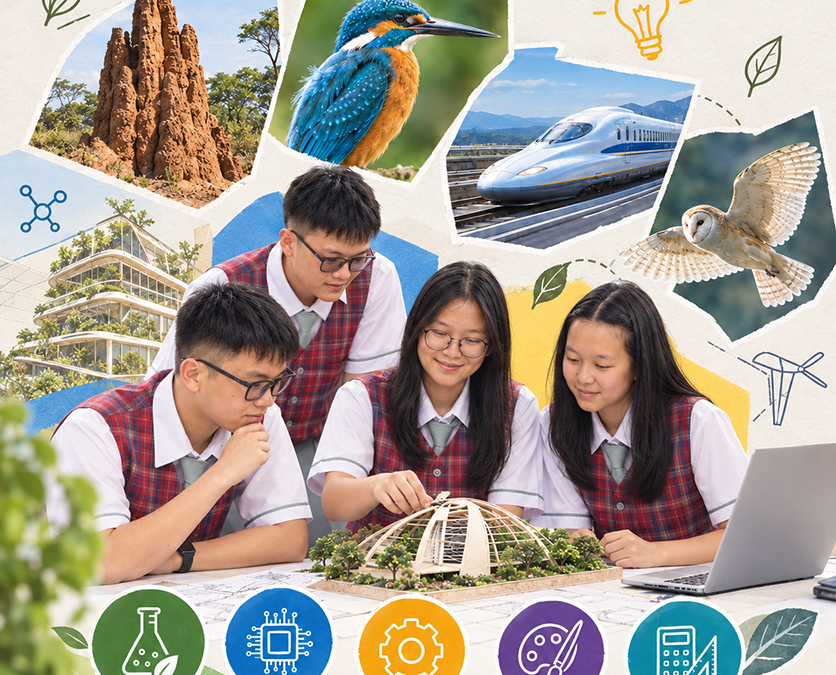
Biomimicry is more than just copying nature; it is about understanding the underlying principles behind natural designs. From the structural efficiency of a termite mound (which inspired passive cooling architecture) to the aerodynamics of a kingfisher’s beak (which inspired the Shinkansen bullet train), the natural world is full of inspiration for human innovation.
For students, this concept opens doors to endless possibilities. It encourages them to look at the world not as a resource to be exploited, but as a mentor to be respected.
How Biomimicry Connects to STEAM
The STEAM framework provides the perfect lens through which to explore biomimicry:
- Science: Students can research biological adaptations and ecological principles.
- Technology & Engineering: They can design and build prototypes inspired by natural systems.
- Arts: They can sketch biological designs and create visual models to communicate their ideas.
- Mathematics: They can calculate ratios, angles, and efficiency metrics based on natural geometry.
A Vision for the Future
Imagine a classroom where students tackle real-world problems by asking, “What would nature do?” A group concerned about noise pollution might study the silent flight of owls and design quieter drone propellers. Another group might explore how mangrove roots filter water and apply that principle to urban water management systems.
These kinds of projects are not just about building devices; they are about fostering systems thinking. Students learn that human problems often have natural solutions that have evolved over millions of years.
We envision a future where STEAM initiatives like biomimicry will build a legacy of critical thinkers and creative problem-solvers. This concept encourages our students to view the world with curiosity and respect.
As we continue to explore innovative pedagogies, we remain committed to nurturing a generation that is not only technologically proficient but also deeply connected to the natural world. The future is not just about what we can create; it is about what we can learn from the world around us.
Author:
Hendra Tan, M.Pd.
Curriculum and Evaluation Department,
PENABUR INTERCULTURAL SCHOOL